Perplexity SEO: How to Get Your Site Cited in Perplexity AI Answers
A practical guide to Perplexity SEO — allow PerplexityBot, structure content for AI answers, and improve your chances of being cited in Perplexity search results.
By Mubashir Hussain · CrawlReady AI · Human-reviewed technical guide
Some guides may be AI-assisted and are always human-reviewed for accuracy before publish. See our Google generative AI search guide and Google's AI content guidance.
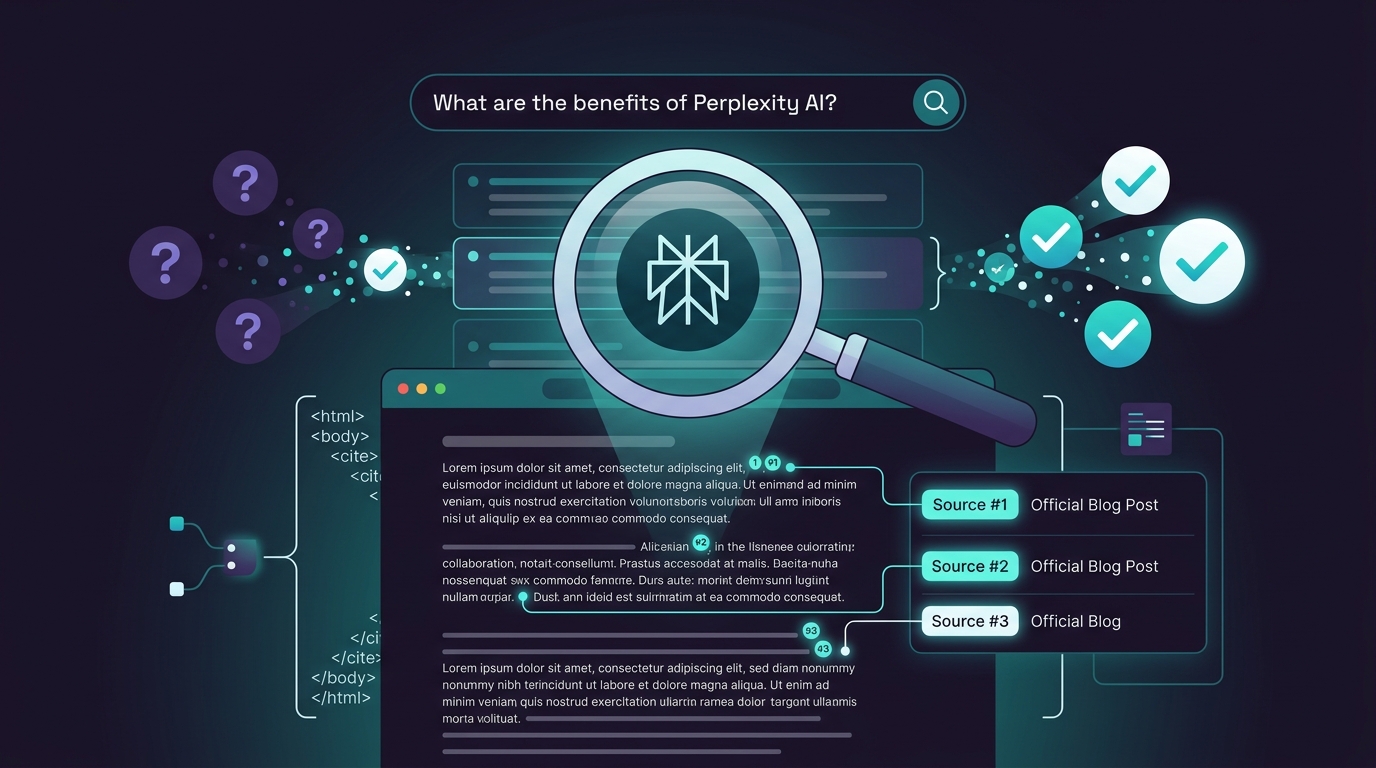
Perplexity AI is one of the fastest-growing AI search engines, with tens of millions of users asking questions and expecting cited, accurate answers. If your website appears as a Perplexity source, you get a visible citation link and a share of that referral traffic. This guide explains exactly how to optimise for Perplexity — technically and content-wise.
How Perplexity finds and cites websites
Perplexity works differently from Google. When a user asks a question, Perplexity runs a live web search, fetches several pages, reads their content, and synthesises an answer — citing the sources it used. This means two things:
- Your page needs to be crawlable by PerplexityBot at fetch time
- Your content needs to directly and clearly answer the kind of question Perplexity users ask
Unlike traditional SEO where ranking takes weeks, Perplexity can surface a page it has never seen before — as long as it can fetch it when a relevant query is made. This makes technical access critically important.
Step 1: Allow PerplexityBot in robots.txt
The first thing to check is whether PerplexityBot is allowed on your site. Use the Perplexity Crawler Checker to see your current status instantly.
To explicitly allow PerplexityBot, add this to your robots.txt:
User-agent: PerplexityBot
Allow: /
If you have a blanket Disallow: / under User-agent: *, you must add a specific PerplexityBot block above it — more specific rules take precedence:
User-agent: PerplexityBot
Allow: /

User-agent: *
Disallow: /admin/
Disallow: /checkout/
Use the AI Robots.txt Generator to build correct rules for all major AI crawlers at once, including PerplexityBot, GPTBot, OAI-SearchBot, and ClaudeBot.
Step 2: Ensure pages load correctly for a crawler
Perplexity fetches pages in real time when a query is made. If your page is slow, broken, or behind a login, Perplexity will skip it and cite a competitor instead. Check these:
- HTTPS — Serve pages over HTTPS. HTTP pages are increasingly skipped by AI crawlers.
- Fast TTFB — Time to first byte should be under 500ms. Slow servers make real-time fetching unreliable.
- HTTP 200 status — Pages returning 4xx or 5xx errors will not be read. Fix broken URLs before expecting citations.
- No login required — PerplexityBot cannot authenticate. Public pages only.
- Server-rendered HTML — If your content is loaded by JavaScript after the initial page load, PerplexityBot may not see it. Put your key content in the initial HTML response.
Step 3: Write content that Perplexity wants to cite
Getting crawled is necessary but not sufficient — Perplexity still has to choose your page over dozens of others. The pages Perplexity cites most often share these characteristics:
Direct answers at the top
Perplexity's AI reads the first few hundred words of a page with the most weight. If you bury the answer to a question halfway down a 3,000-word article, Perplexity is less likely to pick your page as the primary citation. Lead with the answer, then provide context and detail below.
Factual, specific content
Perplexity users ask specific questions and expect specific answers. Vague or heavily hedged content is less likely to be cited. Include numbers, dates, code examples, and named entities wherever they are accurate and relevant.
Clear headings that match query intent
Use H2 and H3 headings that directly reflect common questions in your topic area. Perplexity maps page sections to query intent — a heading that says "How to allow PerplexityBot in robots.txt" is more citable for that specific query than "Configuration options."
Short, scannable paragraphs
Keep paragraphs to 3–5 sentences. AI systems that synthesise content find it easier to extract a clean, quotable sentence from a short paragraph than from a wall of text.
Step 4: Add structured data
JSON-LD structured data helps Perplexity (and all AI search engines) understand what your page is about without having to interpret the prose. Useful schema types for Perplexity SEO:
- Article — For blog posts and guides. Includes
headline,datePublished, andauthor. - FAQPage — For pages that answer common questions. Even though Google has reduced FAQ rich results, AI engines like Perplexity still use FAQ schema to identify directly answerable questions.
- HowTo — For step-by-step guides. Perplexity frequently cites how-to content in instructional answers.
Use the Schema Checker to see what structured data is currently present on your pages and whether it is valid.
Step 5: Build topical authority
Perplexity favours sources that are clearly authoritative on a topic. A specialist site covering AI crawlers in depth is more likely to be cited for AI crawler questions than a generic tech blog with one post on the subject. Build topical authority by:
- Publishing multiple pieces of content that cover your topic from different angles
- Linking related articles to each other with descriptive anchor text
- Including factual citations in your own content (links to official documentation, research, and primary sources)
- Keeping content up to date — Perplexity notes when content was published and may deprioritise stale articles for time-sensitive queries
Step 6: Publish llms.txt
A /llms.txt file at your domain root is a plain-text index of your most important pages, written for AI systems. It helps Perplexity and other AI engines understand your site structure without having to crawl every URL. Include your key pages, their descriptions, and their URLs.
Use the LLMs.txt Generator to create one automatically from your homepage.
Monitoring Perplexity citations
Unlike Google Search Console, there is no official Perplexity analytics dashboard. To monitor whether your site is being cited:
- Check your server access logs for requests from
PerplexityBot— confirms the crawler is visiting - Search your topic area directly on Perplexity.ai and see if your site appears in citations
- Monitor referral traffic in your analytics for
perplexity.aias a referrer - Set up Google Alerts for your brand name alongside "perplexity" to catch third-party mentions
Perplexity SEO vs Google SEO
The two are complementary rather than competing. Strong Google SEO — authoritative content, fast pages, clean technical setup — is the foundation for Perplexity citations too. The main differences to be aware of:
- Perplexity cites sources inline and gives you a visible link even when you're not ranked #1 on Google
- Perplexity can cite newer content much faster than Google — a page published today can be cited tomorrow if PerplexityBot fetches it for a relevant query
- Perplexity rewards directness and factual density more than keyword-optimised prose
- Traditional SEO signals like backlink count matter less to Perplexity than they do for Google rankings
Perplexity SEO quick checklist
- robots.txt allows PerplexityBot with
Allow: / - Pages return HTTP 200 over HTTPS with fast TTFB
- Key content is in server-rendered HTML, not JavaScript-only
- Articles open with a direct answer to the target question
- Headings reflect specific question intents
- JSON-LD Article or FAQPage schema is present
- llms.txt is published at domain root
- Internal links connect related content on your site
- Server logs confirm PerplexityBot visits
Start by checking your current PerplexityBot status with the free Perplexity Crawler Checker, then run a full AI Crawler Check to see the status of all major AI bots at once.
Frequently Asked Questions
What is Perplexity SEO?
Perplexity SEO means optimising your website so PerplexityBot can crawl it and Perplexity's AI engine selects your pages as sources in its answers. It combines technical access (robots.txt) with content clarity and authority signals.
What crawler does Perplexity use?
Perplexity uses PerplexityBot as its primary crawling user-agent. It respects robots.txt directives and identifies itself with the string PerplexityBot in HTTP requests.
Does blocking PerplexityBot stop my content from appearing in Perplexity?
Yes. If PerplexityBot is blocked in robots.txt, Perplexity cannot fetch your pages. Your content will not appear as a cited source in Perplexity answers for queries your pages would otherwise be relevant to.
How do I check if PerplexityBot is blocked on my site?
Use the free Perplexity Crawler Checker at crawlreadyai.com/perplexity-crawler-checker. Enter your URL and it parses your live robots.txt to show whether PerplexityBot is allowed or blocked.
Is Perplexity SEO the same as traditional SEO?
It overlaps significantly — both reward clear, authoritative, well-structured content. The key difference is that Perplexity synthesises answers from multiple sources and cites them inline, so concise, factual paragraphs that directly answer questions tend to perform better than long-form SEO content written for keyword density.
Important disclaimer
This guide is for educational purposes only. No tool or technique guarantees search rankings, AI inclusion, or specific traffic results. Refer to official documentation from search engines and AI providers for current policies.