ClaudeBot SEO Guide: How to Optimise for Anthropic's AI Crawler (2026)
Learn how ClaudeBot works, how to allow it in robots.txt, and how to optimise your website content to appear as a source in Claude AI answers. Complete ClaudeBot SEO guide for 2026.
By Mubashir Hussain · CrawlReady AI · Human-reviewed technical guide
Some guides may be AI-assisted and are always human-reviewed for accuracy before publish. See our Google generative AI search guide and Google's AI content guidance.
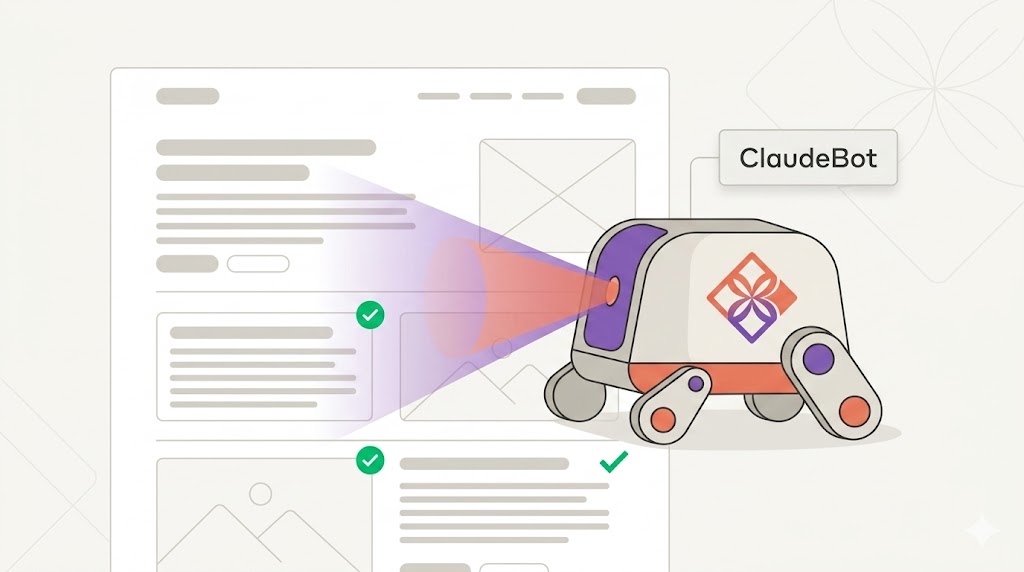
ClaudeBot is Anthropic's web crawler — the system that lets Claude AI learn from and reference publicly available web content. As Claude becomes one of the most widely used AI assistants in the world, appearing as a trusted source in Claude's answers is becoming a meaningful traffic and authority signal. This guide explains exactly how ClaudeBot works and how to optimise your website for it.
What is ClaudeBot?
ClaudeBot is the primary web crawler operated by Anthropic, the company behind Claude AI. It visits publicly accessible webpages and collects content that is used to:
- Update and expand Claude's knowledge base
- Improve Claude's factual accuracy and coverage
- Index content that Claude can reference when answering questions
ClaudeBot identifies itself with the user-agent string ClaudeBot. Anthropic also operates a second crawler called Claude-Web, which is used specifically when a Claude user asks Claude to browse the web or read a URL in real time.
ClaudeBot vs Claude-Web: what's the difference?
Understanding the two user-agents is important for robots.txt configuration:
- ClaudeBot — Bulk crawler. Runs continuously across the web collecting content for Anthropic's systems. Similar role to GPTBot for OpenAI. User-agent:
ClaudeBot. - Claude-Web — On-demand browser. Activated when a Claude user explicitly shares a URL or asks Claude to search the web. Fetches pages in real time. User-agent:
Claude-Web.
For full visibility in Claude — both in its pre-trained knowledge and in live web browsing responses — you need to allow both user-agents.
How to allow ClaudeBot in robots.txt
Both ClaudeBot and Claude-Web respect robots.txt. The correct configuration to grant full access:
User-agent: ClaudeBot
Allow: /

User-agent: Claude-Web
Allow: /
If your robots.txt has a User-agent: * section with Disallow: /, you must add these sections explicitly above or below the wildcard block — specific user-agent rules take precedence over the wildcard.
How to block ClaudeBot
If you want to opt out of Anthropic's crawling:
User-agent: ClaudeBot
Disallow: /

User-agent: Claude-Web
Disallow: /
You can block one without blocking the other. For example, blocking ClaudeBot prevents training data collection while still allowing Claude users to share your URLs with Claude for real-time reading.
Partial access: protect specific sections
Allow ClaudeBot to read your public content while keeping sensitive areas private:
User-agent: ClaudeBot
Allow: /blog/
Allow: /guides/
Allow: /tools/
Disallow: /admin/
Disallow: /dashboard/
Disallow: /api/
Verifying ClaudeBot is crawling your site
Check your server access logs for ClaudeBot activity:
grep -E 'ClaudeBot|Claude-Web' /var/log/nginx/access.log | tail -20If you see entries, Anthropic's crawlers are actively visiting your pages. No entries could mean your robots.txt is blocking them or they have not yet crawled your domain.
You can also use the AI Crawler Checker to scan your robots.txt and confirm ClaudeBot access with a single click.
How Claude decides what to cite
Allowing ClaudeBot is the technical first step. To actually appear as a cited source in Claude answers, your content needs to meet the quality signals that Anthropic's systems prioritise:
Factual accuracy and depth
Claude is designed to give accurate, well-reasoned answers. Pages that contain specific, verifiable facts — with clear sourcing where applicable — are more likely to be indexed and cited. Avoid vague generalisations and back claims with data or examples.
Clear, direct answers
Claude users ask direct questions. Content that answers a question in the first paragraph — without lengthy preamble — is easier for Claude to extract and cite. Lead every major section with the answer, then provide supporting detail.
Structured content
Use meaningful H2 and H3 headings that reflect specific questions. Use numbered lists for steps and bullet points for features or comparisons. Add FAQPage JSON-LD schema to signal your question-answer structure to AI systems.
Author and entity signals
Anthropic's systems apply authority signals similar to Google's E-E-A-T framework. Include author information with relevant credentials, an About page explaining your expertise, and Organization JSON-LD schema with sameAs links to your social profiles and mentions on other reputable sites.
Up-to-date content
Stale content with old dates gets deprioritised. Keep key pages updated and ensure your Article schema's dateModified reflects actual recent updates — not just a date change with no content edit.
Content types that perform best with Claude
Based on the kinds of sources Claude references most often, these content formats perform well:
- Technical how-to guides — Step-by-step instructions with code examples or commands. Claude users frequently ask "how do I…" questions and Claude cites authoritative technical guides.
- Definition and explanation pages — "What is X" and "How does X work" pages map directly to common Claude queries. Structure these with a clear opening definition followed by detailed explanation.
- Comparison and reference pages — "X vs Y" comparisons and reference tables (like robots.txt syntax references) are cited frequently because they provide compact, structured information.
- FAQ pages — FAQ content maps directly to conversational queries. Back with FAQPage JSON-LD schema.
- Original data and research — If you publish original statistics, studies, or survey results, Claude and other AI systems will cite them as primary sources. This is a powerful long-term strategy.
Complete robots.txt for all AI crawlers
To maximise visibility across all major AI search engines simultaneously:
User-agent: ClaudeBot
Allow: /

User-agent: Claude-Web
Allow: /

User-agent: GPTBot
Allow: /

User-agent: OAI-SearchBot
Allow: /

User-agent: PerplexityBot
Allow: /

User-agent: Google-Extended
Allow: /

User-agent: CCBot
Allow: /
Generate a custom version with the AI Robots.txt Generator, then verify all crawlers can access your site with the AI Crawler Checker.
ClaudeBot quick reference
- User-agent (bulk crawler):
ClaudeBot - User-agent (real-time browser):
Claude-Web - Operated by: Anthropic
- robots.txt compliance: Full — respects both Disallow and Allow rules
- Crawl-delay support: Not officially documented — use server-level rate limiting if needed
- Sitemap support: Reads Sitemap declarations in robots.txt
- Effect on Google rankings: None — completely separate from Googlebot
Run a free AI Crawler Check to verify ClaudeBot access on your site, or use the AI Search Visibility Checker for a full audit across all AI search engines.
Frequently Asked Questions
What is ClaudeBot?
ClaudeBot is Anthropic's web crawler, used to collect publicly available web content that helps train and improve Claude AI models. Its user-agent string is 'ClaudeBot'. Anthropic also operates 'Claude-Web', a second user-agent used for real-time web browsing within Claude.
How do I allow ClaudeBot in robots.txt?
Add two explicit Allow rules in robots.txt — one for ClaudeBot and one for Claude-Web: User-agent: ClaudeBot / Allow: / and User-agent: Claude-Web / Allow: /. Both user-agents are needed to fully opt in to Anthropic's crawling and browsing systems.
Does ClaudeBot affect my Google rankings?
No. ClaudeBot is operated by Anthropic and is completely separate from Googlebot. Allowing or blocking ClaudeBot has no effect on your Google Search rankings. They are independent systems with no connection to each other.
How is ClaudeBot different from Claude-Web?
ClaudeBot is used for bulk crawling and training data collection. Claude-Web is used when a Claude user explicitly asks Claude to browse a specific URL or search the web in real time. To appear in Claude's direct responses, you need to allow both user-agents.
Can I block ClaudeBot but still appear in Claude answers?
If you block ClaudeBot, Anthropic cannot crawl your site for training or indexing. However, if Claude-Web is allowed, users can still share your URL directly with Claude and Claude will be able to read it in that context. For maximum visibility in Claude answers, allow both ClaudeBot and Claude-Web.
Important disclaimer
This guide is for educational purposes only. No tool or technique guarantees search rankings, AI inclusion, or specific traffic results. Refer to official documentation from search engines and AI providers for current policies.