Google AI Overviews: How to Get Cited in Google's AI Search Results (2026)
A practical guide to Google AI Overviews — how Google selects sources, the role of Google-Extended and Googlebot, and how to structure content to get cited instead of just ranked.
By Mubashir Hussain · CrawlReady AI · Human-reviewed technical guide
Some guides may be AI-assisted and are always human-reviewed for accuracy before publish. See our Google generative AI search guide and Google's AI content guidance.
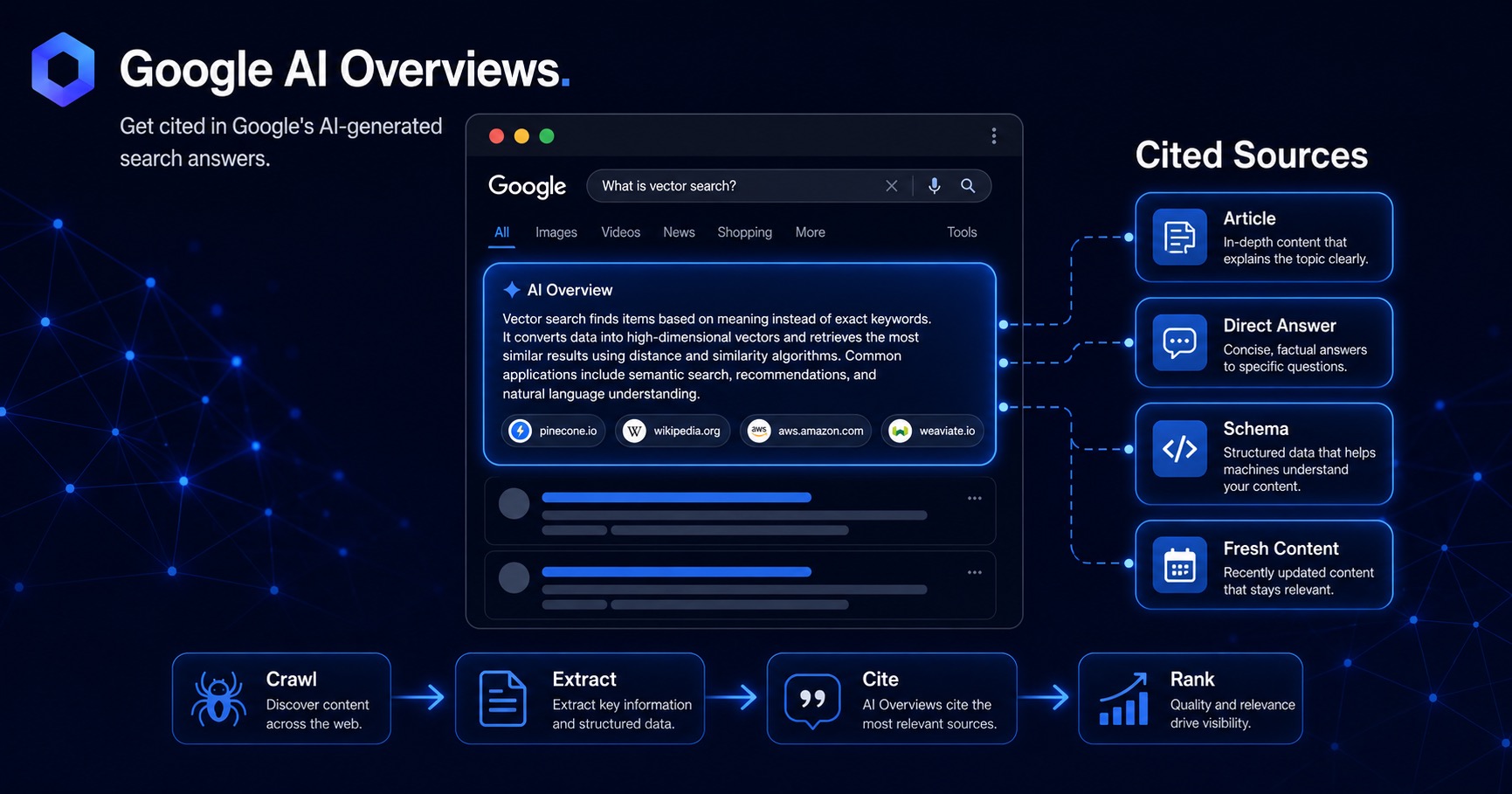
Google AI Overviews now appear on a large share of Google searches, placing an AI-generated summary above the traditional blue links — with source citations built in. Getting cited there puts your site in front of users before they scroll to organic results. This guide explains how AI Overviews selects sources and what to change on your site to be one of them.
What is Google AI Overviews?
AI Overviews is Google's generative answer box, powered by Gemini and Google's Search index. For queries where Google judges an AI-synthesised answer to be useful, it generates a summary drawing from several web pages and displays clickable source links alongside it. Unlike the old "featured snippet," which pulled from a single page, AI Overviews typically cites three to six sources in one answer.
How AI Overviews differs from ranking #1
Traditional SEO optimises for a ranking position. AI Overviews optimises for extractability — whether Google's model can lift a clean, self-contained answer out of your page and attribute it to you with confidence. This means:
- Pages ranking #4 or #5 can be cited over the #1 result if their answer is more directly extractable
- Multiple pages from the same domain rarely appear together — Google tends to diversify sources
- Being cited does not always produce a click — some users read the summary and stop, so citation volume and referral traffic should be tracked separately
Step 1: Confirm Google can crawl and index your pages
AI Overviews is generated from Google's existing Search index — a page must be indexed by Googlebot before it can ever be cited. Check the basics first:
- robots.txt allows Googlebot — no blanket
Disallow: /forUser-agent: Googlebot - No noindex — check
<meta name="robots">and theX-Robots-TagHTTP header - Page is indexed — verify with a
site:search or the URL Inspection tool in Google Search Console - Google-Extended — this token controls Gemini model-training use of your content, not Search indexing. Leaving it unset or allowed does not affect whether you can be cited in AI Overviews
Run the Google AI Overview Checker to see your current crawl and eligibility status, or the AI Crawler Checker for a full scan across Googlebot and other AI crawlers.
Step 2: Write the answer in one extractable passage
Google's summarisation model favours a single paragraph that fully answers the query without requiring the reader to piece together information from multiple sections. Structure each target page like this:
- A heading that mirrors the actual question (e.g. "How do I check if Google-Extended is blocked?")
- A 2–3 sentence direct answer immediately below it
- Supporting detail, examples, or data afterward — for readers, not extraction
Avoid splitting the core answer across two separate paragraphs or burying it after a long preamble. If the answer requires stitching together sentences from different parts of the page, Google is more likely to cite a competitor whose answer is self-contained.
Step 3: Match the query's actual phrasing
AI Overviews is triggered by specific query patterns — questions, comparisons, "how to," and "best" queries in particular. Headings and opening sentences that closely mirror how people actually phrase a question outperform generic section titles. Compare:
- Weak heading: "Crawler Access"
- Strong heading: "Does blocking Google-Extended affect AI Overviews?"
The strong version matches a real query pattern almost verbatim, making it trivial for Google's model to lift as a citation-ready answer.
Step 4: Add structured data
Structured data does not directly cause AI Overview citations, but it gives Google unambiguous signals about page type, authorship, and freshness — all of which factor into source trust. Prioritise:
- Article —
headline,datePublished,dateModified,author - FAQPage — still useful for AI Overviews even though Google removed the separate FAQ rich-result dropdown for most sites in May 2026 (see our FAQ rich results guide)
- HowTo — for step-by-step content
- Organization with
sameAs— reinforces entity identity and trust signals
Validate what is currently on your pages with the Schema Checker.
Step 5: Keep content current
AI Overviews weighs freshness more heavily than typical organic results for time-sensitive topics — pricing, statistics, product features, and "as of [year]" facts. Update dateModified whenever you materially revise a page, and avoid stale numbers or version references that make a page look outdated to both readers and Google's model.
Step 6: Measure your AI Overview presence
Google Search Console reports AI Overview impressions and clicks under Search Results, filterable by Search Appearance. Track this alongside:
- Manual spot checks — search your target queries directly and note whether your domain appears in the AI Overview citations
- Server logs — confirm active Googlebot crawl frequency on the pages you are targeting
- Click-through rate changes — AI Overviews can reduce CTR on queries it answers directly, even for cited pages; track this per query group rather than site-wide
What does not work
- Stuffing a page with keyword variants instead of one clear answer
- Assuming schema markup alone earns a citation without a genuinely extractable answer
- Blocking Google-Extended expecting it to affect AI Overview eligibility — it does not; that is a training opt-out, not a Search opt-out
- Writing long, hedged answers that never commit to a direct statement
Google AI Overviews checklist
- robots.txt allows Googlebot on target pages
- No noindex meta tag or X-Robots-Tag on pages you want cited
- Page is confirmed indexed in Google Search Console
- Each target query has one heading that mirrors its real phrasing
- A direct 2–3 sentence answer sits immediately under that heading
- Article, FAQPage, or HowTo schema present where relevant
- dateModified is accurate and current
- AI Overview impressions tracked in Search Console Search Appearance filter
Run a free Google AI Overview Checker scan to see your current eligibility status, or use the AI Search Visibility Checker for a score across Google, ChatGPT, Perplexity, and Claude at once.
Frequently Asked Questions
How do I get cited by Google AI Overviews?
Keep the page crawlable and indexable, put a direct answer near the top, and use accurate structured data. Then test technical eligibility with the AI Overview Checker. Citation is not guaranteed — Google also weighs content quality and competition.
What is Google AI Overviews?
Google AI Overviews is an AI-generated summary that appears above traditional blue-link results for many search queries. It synthesises an answer from multiple web pages and cites the sources it draws from, similar to how ChatGPT search or Perplexity present answers.
Do I need to rank #1 to appear in AI Overviews?
No. Google draws AI Overview citations from a broader pool than the top organic result — pages ranking anywhere on page one, and sometimes page two, can be cited if they contain a clear, well-structured answer to the query.
Does blocking Google-Extended affect AI Overviews?
Google has stated that Google-Extended controls use of your content for Gemini and future generative AI model training, separate from Googlebot's indexing for Search. However, AI Overviews are generated from Google's Search index, so blocking Googlebot itself — not Google-Extended — is what removes you from AI Overview eligibility.
Can I opt out of AI Overviews specifically?
There is no dedicated meta tag to opt a page out of AI Overviews while keeping it in regular search results. The nosnippet meta tag prevents Google from using your content in both snippets and AI Overviews, but it also removes your regular text snippet from search results.
Why did a competitor with a lower ranking get cited in AI Overviews instead of me?
AI Overviews selection is not purely rank-based. Google favours passages that directly and concisely answer the query's specific phrasing. A page ranking lower but with a tighter, more extractable answer can be cited over a higher-ranking page with a vaguer or longer explanation.
Important disclaimer
This guide is for educational purposes only. No tool or technique guarantees search rankings, AI inclusion, or specific traffic results. Refer to official documentation from search engines and AI providers for current policies.